
After much good news for President Vladimir Putin, thanks to Donald Trump’s blundering intervention in the Middle East, the remarkable result of Hungary’s election on Sunday night is a serious setback for the Russian despot. Which the American vice-president’s blundering intervention in Mitteleuropa last week clearly did nothing to stop.
There has been no greater friend to Russian interests among EU leaders than Viktor Orbán, whose defeat leaves his country with new rulers. They will inherit a Hungary still dependent on Russian energy, while its reputation – and Orbán’s – has been sullied by links with the Kremlin. In the final days of the election campaign, audio emerged that appeared to show Orbán’s foreign minister, Péter Szijjártó, agreeing to pass sensitive European Union papers to Putin’s government. Likewise, Orbán had been openly blocking a vital €90bn EU loan to Ukraine.
This sucking up to Russia seems to have played a key part in his government’s heavy defeat at the hands of his former loyalist, Péter Magyar. As the BBC’s Rajini Vaidyanathan reported from Budapest, “Everyone I’ve spoken to among the crowd has said the relationship between Hungary and Russia was what defined their vote.” At his victory rally, a triumphant Magyar declared that “we want to be a country that is no one’s vassal”, but instead to be “a European country” once again.
And in response, his supporters chanted “Ruszkik haza!” – “Russians go home!” – which echoed many other celebrating voices across the capital – and doubtless across Europe. Protesters had even shouted this slogan at Orbán’s own rallies during the campaign. ITV reported that the phrase “had gained increasing currency amid Orbán’s drift toward Moscow.” The words cut deep into Hungary’s modern history.

In 2016, making an oral history series for BBC Radio 4 about the key crises of the Cold War, I had the chance to interview a man called Mátyás Sárközi. On 23 October 1956, he was working as a journalist in Budapest when a student demonstration mushroomed into revolution against the Soviet domination of Hungary, which had been enforced ever since the end of the Second World War. At first, the students tentatively chanted that soldiers of all nations should go home. This was brave enough, but within hours, they were chanting “Ruszkik haza!”. The scene Sárközi recreated 60 years later continues to play on my mind; one of those electric moments radio producers live for.
As Sárközi and other young rebels told me, before the night of the 23rd was over, the hard-line communist regime had rejected the students’ demands for greater freedom; workers had joined the uprising, Budapest’s 30-foot statue of Stalin had been cut down, and gun battles with the regime’s security forces had broken out. Amid the fighting outside the city’s radio station, Sárközi saw a student lying dead in the street. Soviet tanks arrived – but eventually withdrew.
For an ecstatic moment, it looked as though they had won. It seemed the reformist communist leader, Imre Nagy, who had been reinstated and had taken the country out of the Warsaw Pact military alliance imposed by Moscow, would carry on, perhaps at the head of a coalition. But then the tanks returned, in immense numbers, and smashed the capital to pieces. Nagy was tricked out of hiding, and eventually hanged. Like many of his young comrades, Sárközi fled across the border to the West, and came to the UK, where LSE students volunteered to teach the refugees English.
This was not the first time Russian forces had crushed Hungarian hopes of freedom. On the day the revolution began, the students laid a wreath at the foot of a statue commemorating a Polish general who had fought with the Hungarians in their revolution against Habsburg rule in 1848-49 – before reinforcements dispatched by Tsar Nicholas I helped to put the revolt down. This too is in Hungarian minds again today. The Times reported István Kapitány, the probable minister for the economy in Magyar’s new government, comparing their victory to the revolutions of 1848 and 1956 alike.
The ghosts of 1956 were only laid to rest, if they ever were, in 1989, when Hungary began another revolution against Soviet hegemony. This time, its signature events were not street fighting or the lynching of the security police, as in 1956. One was a huge “Pan-European picnic” on the border with Austria – where restrictions had been loosened, opening the way for East Germans to break through the Iron Curtain, bringing the whole rusty contraption clattering to the ground. Another was the ceremonial reburial of Nagy, which brought more than 100,000 Hungarians to Budapest’s Heroes’ Square. The final orator that day was a young liberal activist who gave an impassioned speech, demanding that the Soviets leave Hungary.
It made the young activist’s reputation. His name was Viktor Orbán.
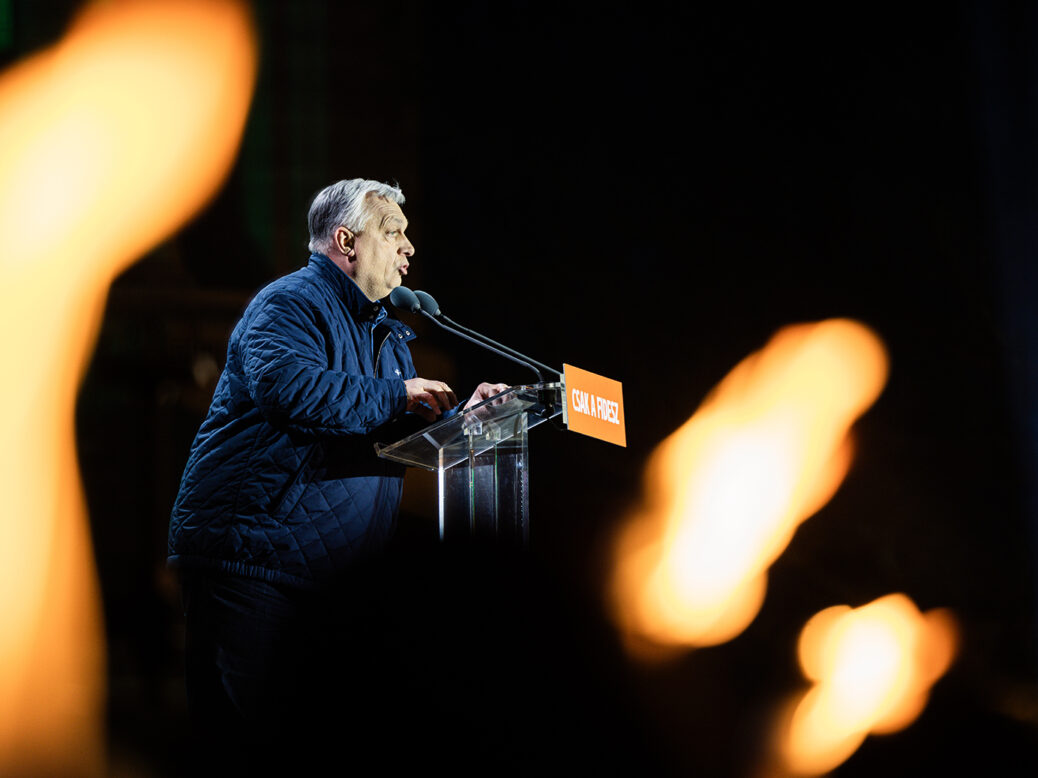
On 15 March 2024, a national holiday which commemorates the revolution of 1848, Orbán – now prime minister of long-standing, but very much no longer a liberal – gave a speech on the steps of the National Museum, attacking the EU and branding Magyar’s Tisza party as “warmongers”. Magyar shot back, at a rally of his own, asking “Mr Prime Minister, why won’t you say ‘Russians go home’ any more?”
The Hungarian Revolution of 1956 may have been broken in the most brutal fashion, but it had a huge impact in the West, hobbling support for the Soviet Union, and spurring the creation of the New Left. The Hungarian revolution of 1989 was not broken – the Soviet leader Mikhail Gorbachev had made clear that there would be no more tanks rolling down European streets – and had a huge impact in the east, triggering the end of the whole Soviet experiment.
Today, Hungarian bravery leads the way again, in the struggle against another hard-faced ideology. As Magyar looks prepared to unblock that vital EU loan to Ukraine, this new Hungarian revolution will prove its significance swiftly enough.
But Tisza’s huge victory on a huge turnout also suggests that Orbán’s weird version of nationalism, which is so keen to kowtow to a dominant foreign power, is not unbeatable. Not for the first time, there might be a lesson in this Hungarian revolution for the rest of us.
[Further reading: Has Reform UK discovered human rights?]
Content from our partners


Related
Join the debate
Subscribe here to comment